

Everything you need to know about producing your own show PART ONE
How to find venues in any city, determine a rental structure, and much more:

I’ve produced well over 150 public shows in the past three years. Some were lineup shows (my show Stand-Up Magic with Jason Silberman and Tess Tregellas), international fringe shows (Mental with Tess Tregellas), and solo shows, like Strangers, that I recently toured nationwide.
Public shows offers the most creative freedom: you perform on your own terms. If you can guarantee ticket sales, you can guarantee income.
Here’s everything you need to know about finding, timing, booking and pricing a successful public show. (This is Part One—the post was literally getting too long. Next week, Part Two will cover everything starting at the actual show and beyond).
Let’s get into it:
Location
Location is key. You want a place that’s easy for your audience to get to. An extraordinary space in the outer boroughs will fail your prime audience in Manhattan.
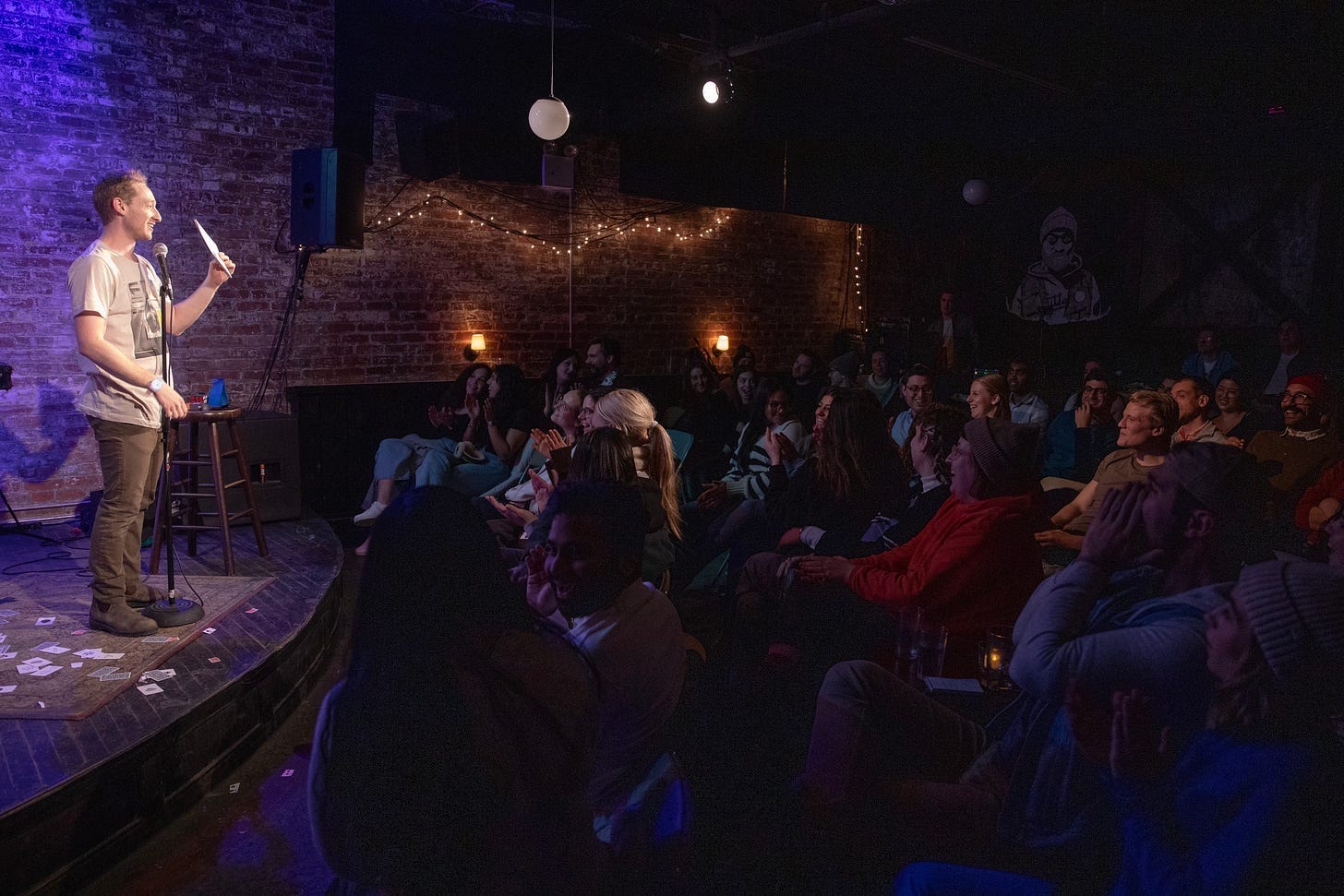
When people come into the room, they should instinctively comment on how much they like the space. Until people are doing that, it’s not good enough.
To be clear, good does not mean fancy — it means the room has a distinct, intentional vibe. People loved The Gutter (photo below), and it was a dive bar. But it was cool.
How to find a venue:
This is not easy. The most basic approach is to google “venues to rent,” but we all know that word of mouth is critical. If you’ve already asked your friends for suggestions and come up dry, there’s a different strategy.
When I had to book a 10-city nationwide tour in under two weeks, here’s what I did:
First, I used Eventbrite. I set my location to the target city and searched for “comedy.”
I knew that any venue that could support a comedy show could support my show. Likewise, because the venue already used Eventbrite, I knew they understood my ideal ticketing structure.
Finally, I reached out to venues if I felt that they were a good fit.
This is obviously very simple, but you can see how it’s much more effective than a Google search, because I’m searching within a certain demographic.
So let’s say you found a venue: Now what?
The Three Layers of Negotiation
Venues offer three types of deals. Know which one favors your bottom line:
Rental fee: This is a flat fee that gives you access to the venue for a certain amount of time. Simple.
Ticket split: The venue takes a portion of the tickets, and you take a portion of the tickets (a good split is typically 60%-70% in favor of the artist). Venues will often do a ticket split after taking “house fees,” which pays for their staff on the night.
A basic structure might look like: $300 in house fees, and the artist takes 70% of the remaining box office proceeds.
Bar minimum: This can be the best option if you get it. The venue takes bar sales, and you, the artist, keep 100% of the ticket sales. In this case, the bar sales cover what a rental fee would be.
How should you decide? Most of the time, you won’t have a blanket choice. The venue will likely may you an offer based on their standard business operations.
However, often you’ll get to choose between a rental and a ticket split, and in that case, you should estimate how much money you’ll make (Tickets Sales X Ticket Price), and see which option nets you more money.
For example, let’s say you plan on selling 70 tickets at $30 each, for a maximum revenue of $2100. The venue offers you a 70/30 split in your favor or a $600 rental.
A 70/30 split would net you $1470 (which is 70% of $2100), and a $600 rental would net you $1500. So, even though it’s only a $30 difference, the rental is more cost effective.
Of course, you probably won’t be in this exact situation. But doing the math is actually quite simple. Estimate your total revenue, and subtract the percentage the venue takes.
For more information on how to bring that fee down, let’s look at one option:
One or two shows?
You might consider performing two shows in one night. While the costs are of course higher, they usually aren’t double what you paid for one show. Therefore, if you can sell enough tickets, it’s actually quite cost effective to do back to back shows.
Again—ask your venue what these costs are. You don’t have to set any prices yourself except for…
Ticket price
This is 100% in your wheelhouse, and you need to set a proper ticket price.
It is crucial to understand your audience’s demographics and expectations. A $45-$75 ticket might be what you’re worth, but good luck selling that to NYU students.
The point being—you need to provide value for your audience. And you need to know who your audience is.
My standard ticket price is $30. Candidly, I think that’s low and I’d like to raise the price soon. But I also know that I’m knocking people over with value, and they leave wanting more and willing to pay for it.
The bottom line—find a fee that’s reasonable while providing value. For a magic show, $30 is a great place to start, and it can easily be increased with a premium venue.
To fee or not to fee
All ticketing platforms charge a nominal service fee (usually $3-$4), in order to use their service.
Eventbrite, specifically, lets you decide whether to pass that fee onto your ticket buyer, or consume the fee in the ticket price.
There’s no right way to do this, but I do believe that charging your audience a small service fee is completely acceptable.
However, you should be aware that, if your ticket is $35, and the fee bumps it to $38.50, your audience won’t perceive it as a $35 ticket. They’ll perceive it as basically $40.
That’s ok, but you need to remember what your audience thinks. Therefore, if you think that you can’t get away with a $40 ticket (I know I’m rounding up, but so will your audience), then it might be worth it for you to eat the cost and profit only $31.50 instead of $35 if it means getting butts in seats).
Something to unequivocally avoid
I almost never perform at venues with a food and beverage minimum. I think it’s sleazy and always detracts from the audience’s experience.
I’ve never left a show with a two item minimum and thought “Dang, I really liked stressing about what items to buy.”
Often, I’ll pay a higher rental fee out of my own pocket instead of putting that cost on the audience. And while that may sound crazy, it actually has long-term benefits, because the audience will have a better time at your show.
What time should the show start?
If you’re doing one show on a weeknight, I’d recommend 7:00 PM—7:30 PM. Anything other than that is a bit early, but can be justified if you’re doing two shows.
If it’s a weekend, I’ve been impressed by how many people are willing to attend a show that starts between 8:00 PM and 9:30 PM.
Honestly, it’s nice for people to be able to finish their day, have dinner, and go to a show without feeling rushed.
At the end of the day, the show should be less than 90 minutes (more on that next week in Part Two), so it’s not like you’re making them get home at midnight.
The 30 minutes earlier timing strategy
I learned this early in my Stand-Up Magic days, and it’s a godsend. If you want people to show up on time, list the show time as the time that doors open. Meaning—let’s say that doors open at 6:30 PM for a 7:00 PM show.
The ticket should say 6:30 PM.
You then need to communicate in the show description that it actually starts at 7:00 PM, but I promise, people will show up on time for this.
When I simply list the show time as is, we end up starting 10-12 minutes late, which for me, is unacceptable. When I buffer this by 30 minutes, we only start 5-7 minutes late, which is honestly standard.
You may not be worrying much about those 5-7 minute differences, but I care, and I believe your audience does too. You’re at work, and your job is to deliver an on-time performance.
This concludes part one. Next week, we’ll get to the actual show, covering topics like:
How to construct your lineup
How long to make your show
The best ticketing software to use
How to sell tickets
How to properly write an Eventbrite page
How to collect emails to promote the next show
How to send pre and post-show emails
How to set up chairs to push people toward the front row and make the room feel sold out
The importance of selling out
Thanks for reading! I make my living doing public shows, and you can get tickets to upcoming performances here:
April 10th, Denver: Strangers and Friends, 6:30 & 9:00 PM
May 11th, New York: Strangers, 6:30 PM (includes a free drink)
August 6th-30th: Edinburgh: Strangers at the Edinburgh Fringe Festival, 5:50 PM nightly
Excellent advice and very concisely communicated.